Why tooth pain feels worse at night
You got through the day. Then you lay down, and the tooth started pounding. That is not your imagination. Lying flat sends more blood to your head, the room is quiet, and there is nothing else to distract you.
At Dental Solutions in Ghatkopar West, tooth pain at night is one of the most common reasons people call us first thing in the morning. The first question we ask is not "do I need a root canal?" It is "what kind of pain is it?"
That matters because a toothache is a symptom, not a diagnosis. Several different problems can feel the same at 2 a.m., and they are treated very differently. Only an examination and an X-ray can tell them apart.
Five things a toothache can mean
Here are the usual suspects, from the ones that need little to the ones that need a root canal.
A sensitive tooth
A sharp zing with cold water or sweets that fades in seconds. Worn enamel or a receding gum is often behind it. This is irritating, not urgent.
A cavity that has not reached the nerve
Pain when you eat something sweet, hot or cold, which stops soon after. A filling usually solves it, and the sooner it is done, the smaller the filling.
A gum problem
Soreness around the tooth, swollen or bleeding gums, or food stuck between two teeth. The tooth itself may be fine. Our gum treatment page explains what we do here.
A cracked tooth
Pain that shoots when you bite down and let go. Cracks are easy to miss and hard to see yourself, so don't keep testing it.
An infected or inflamed nerve
A deep, throbbing ache that lingers, wakes you at night, or comes without any trigger. This is the one that often leads to a root canal.
The first three can usually be sorted with simple treatment. The last two need to be seen sooner rather than later.
Do I need a root canal? The signs dentists look for
A root canal treats the inside of a tooth when the nerve and pulp are badly inflamed or infected. The dentist cleans the inside, seals it and then protects the tooth, usually with a crown. The aim is to keep your own tooth instead of removing it.
Signs that point towards a root canal
- A deep ache that lingers for minutes or hours after hot or cold
- Pain that wakes you up, or that you can't trace to one trigger
- Swelling in the gum near the tooth, sometimes with a small pimple-like bump
- A tooth that has darkened compared with the ones beside it
- Tenderness when you tap or chew on one particular tooth
None of these confirms a root canal on its own. An X-ray shows what is happening at the root, and a few simple tests tell us whether the nerve is still healthy. That is why we examine before we advise.
When a root canal is not the answer
If the tooth is cracked deep below the gum, or too little of it is left to rebuild, saving it may not be sensible. Then the honest advice is a different plan, such as removal and replacement. If your pain is a short sting with cold water, you almost certainly don't need one at all.
For a full look at the treatment itself, see our root canal treatment page. The NHS also has a clear overview of root canal treatment.
What you can do tonight, and what to avoid
You can't treat the cause at home, but you can make the night easier until you see a dentist.
- Rinse gently with lukewarm water. Very hot or very cold water can set the pain off
- Chew on the other side, and skip anything very hot, cold, sweet or hard
- Raise your head on an extra pillow, which can ease the pounding
- If you already take a pain reliever safely, follow the instructions on the pack. Ask a pharmacist or doctor if you are unsure
Please don't put a crushed painkiller tablet or any other remedy directly on the gum. It can burn the tissue. And don't wait for the pain to "settle" if you have swelling or a fever. Those need a dentist, or a doctor, the same day.
Pain that disappears on its own does not always mean the problem has gone. Sometimes it means the nerve has stopped responding while the infection carries on quietly.
What happens when you come to our Ghatkopar West clinic
The clinic is on the ground floor of Helix-3, off Lal Bahadur Shastri Marg in Shreyas Cinema Lane. Ghatkopar station is on the Central line and Metro Line 1, so it is easy to reach from either side of the tracks.
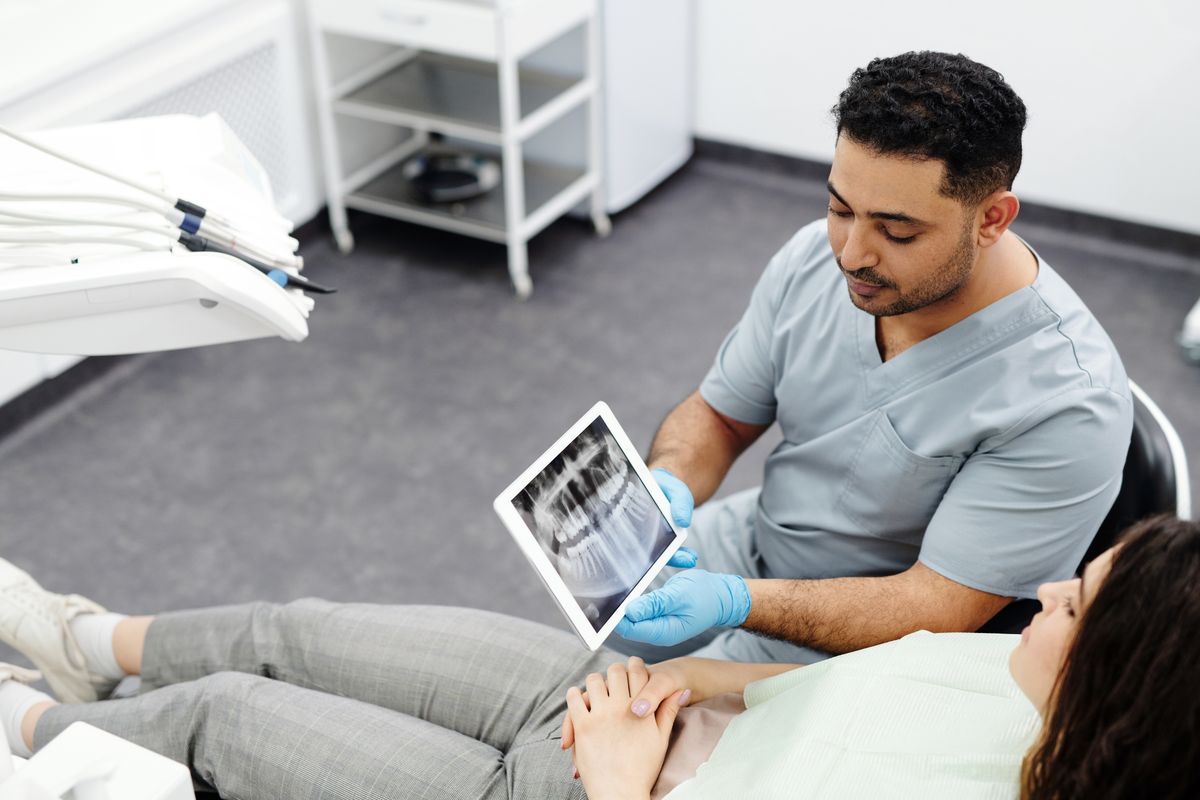
We start by listening. Which tooth, when it began, what sets it off, what eases it. Then we examine the tooth and the gum around it, tap and test it, and take an X-ray. You'll see the X-ray with us and hear what it shows in plain words.
If it is a cavity, a gum issue or a sensitive tooth, we'll tell you so, and you may leave with a much smaller treatment than you feared. If it is a root canal, we'll explain the steps, the number of visits and what protects the tooth afterwards.
Cost depends on the tooth and what it needs, so we give you a quote after the examination, not before. You are welcome to take a day to think, or to get a second opinion.
This page is general information, not a diagnosis. Only an examination can tell you what is right for your teeth.